Da Qing Long Tang: When the Pattern Refuses to Fit

What happens when a classical formula asks us to look beyond the familiar distinction between an open and a closed exterior?
One of the most interesting moments in studying the Shang Han Lun occurs when a formula does not seem to fit the pattern name under which it appears. These moments are not inconveniences to be explained away. They are invitations to look more closely.
Da Qing Long Tang (大青龍湯), Great Blue-Green Dragon Decoction, presents just such a challenge.
In line 38, Zhang Zhongjing describes the pattern as Tai Yang Zhong Feng (太陽中風), usually translated as Tai Yang wind strike. Yet the pulse is floating and tight, there is fever, aversion to cold, generalized body pain, and—most importantly—no sweating. The patient is also vexed and agitated.
For anyone who has learned to distinguish the principal Tai Yang patterns by the state of the exterior, this description raises an immediate question. Why is a pattern called wind strike when its presentation appears so much closer to the closed, constrained exterior of Ma Huang Tang?
Rather than dismissing the terminology as inconsistent, perhaps we should allow the question to teach us something about the medicine.
The familiar distinction: open and closed
Gui Zhi Tang and Ma Huang Tang establish two important therapeutic directions within Tai Yang disease.
In the familiar Gui Zhi Tang presentation, the patient sweats and is averse to wind or cold. The relationship between nutritive and defensive Qi is disharmonious, and the treatment harmonizes their movement while warming and nourishing the exterior.
In the Ma Huang Tang presentation, the patient has no sweating, is averse to cold, and experiences generalized pain. The exterior is constrained, and the treatment opens it and promotes sweating.
These are not simply two collections of symptoms. They describe different functional situations and call for different therapeutic strategies.
We can therefore develop a useful clinical shorthand: an open exterior with sweating suggests one direction of treatment; a closed exterior without sweating suggests another.
But a useful distinction can become a limitation if we mistake it for the whole picture.
The body is not a diagram divided into mutually exclusive categories. The same exterior constraint can exist alongside very different internal conditions. The question is not only whether the exterior is open or closed, but what else is happening within the organism while it remains so.
This is where Da Qing Long Tang becomes especially interesting.
A closed exterior, but not an uncomplicated cold pattern
Consider the signs in line 38.
The pulse is floating and tight. There is fever, aversion to cold, generalized pain, and an absence of sweating. These signs point toward an exterior constrained by cold. The body is attempting to respond to an external influence, but the normal release through the surface is obstructed.
If we stopped here, Ma Huang Tang would seem the obvious choice.
But Zhang Zhongjing adds two characters that change the entire clinical picture:
煩躁 — fán zào: vexation and agitation.
This is the feature that distinguishes the Da Qing Long Tang presentation from an uncomplicated exterior cold pattern.
The patient is not merely cold, constrained, and unable to sweat. There is also heat manifesting as vexation and agitation. The exterior is closed, but the interior cannot be understood through the same cold-constraint logic alone.
We must therefore hold two aspects of the presentation together.
Cold constrains the exterior. Heat is present within the pattern.
Neither aspect can be ignored without losing something essential about the disease.
Da Qing Long Tang is not simply a stronger version of Ma Huang Tang. Nor is it an ordinary exterior pattern with a little extra heat added to it. Its therapeutic direction arises from the relationship between the two conditions.
Why does the formula combine Ma Huang and Gui Zhi with Shi Gao?
The composition of Da Qing Long Tang makes this relationship tangible.
Ma Huang strongly warms and moves Heart Yang, disperses the exterior and promotes sweating. Gui Zhi warms and moves the Heart Yang, assists the movement of Yang through the surface. Together, they address the constraint that prevents sweating.
But the formula does not stop there.
Shi Gao (石膏) is added to clear heat. Its presence is fundamental. The treatment must open the exterior without leaving the internal heat unaddressed.
Shi gao, Gypsum
The Yakucho states, It governs the treatment of vexing thirst, and on the side it treats delirious speech, vexation and restlessness (煩躁 — fán zào: vexation and agitation), and body heat.
Shi gao is pungent, cold, and sweet. The pungent taste disperses while the sweet taste nourishes.
This combination gives the formula its distinctive character: pungent-warm medicinals promote outward release, while a cold medicinal clears heat.
The formula is therefore not choosing between cold and heat, or between opening and closing. It responds to a pattern in which these conditions coexist.
This is an important lesson in classical formula construction. A formula's direction cannot always be understood by identifying its strongest herb or assigning each ingredient to a separate symptom. We must understand how the ingredients work together to address the whole configuration.
Xing Ren (杏仁) further contributes by descending Lung Qi and helping to relieve panting when present. Sheng Jiang, Da Zao, and Zhi Gan Cao complete the formula's particular arrangement of warming, harmonizing, and supporting actions.
The result is a formula that releases a constrained exterior while clearing the heat accompanying that constraint.
Da Qing Long Tang is a combination of Ma Huang Tang and Gui Zhi Tang.
Ma Huang Tang
Ma Huang, Xing Ren, Gui Zhi, and Zhi Gan Cao
Gui Zhi Tang
Gui Zhi, Bai Shao, Sheng Jiang, Da Zao, and Zhi Gan Cao
In combining these two formulas the Bai Shao has been removed and Shi Gao added.
In removing the Bai Shao the formula becomes stronger at warming and moving which helps restore the function of the surface so normal physiological sweating can resume.
In adding Shi Gao the heat is dispersed but also Yin fluids are nourished. The Shi Gao works with the overall direction of the formula to move the warmth outward.
By removing Bai Shao, Gui Zhi Tang becomes Gui Zhi Qu Shao Yao Tang, which is indicated for a faint pulse and aversion to cold. This modification shifts the formula’s emphasis towards warming the exterior and interior, reflecting a greater need to support Yang.
Why call it Tai Yang wind strike?
The apparent contradiction becomes more interesting when we return to the original wording.
The classical line does not call this a straightforward Ma Huang Tang pattern. It identifies it as Tai Yang Zhong Feng, yet describes a floating, tight pulse and an absence of sweating.
We should be careful not to assume that every occurrence of Zhong Feng carries exactly the same diagnostic implications as the familiar Gui Zhi Tang presentation. The formula indication itself requires us to examine the signs rather than impose a rigid definition on the pattern name.
One possible way to understand the wording is that the name identifies the broader Tai Yang disease context, while the pulse and symptoms reveal the particular configuration that requires treatment. Later commentators have offered different explanations of the distinction between wind and cold in this passage.
What matters clinically is that Zhang Zhongjing does not allow the label to replace the examination of the actual pattern.
The text gives us the signs, names the formula, and immediately warns us against using it when the pulse is faint and weak and sweating with aversion to wind is present. The warning makes the point unmistakable: the treatment depends on the complete configuration, not on the pattern name in isolation.
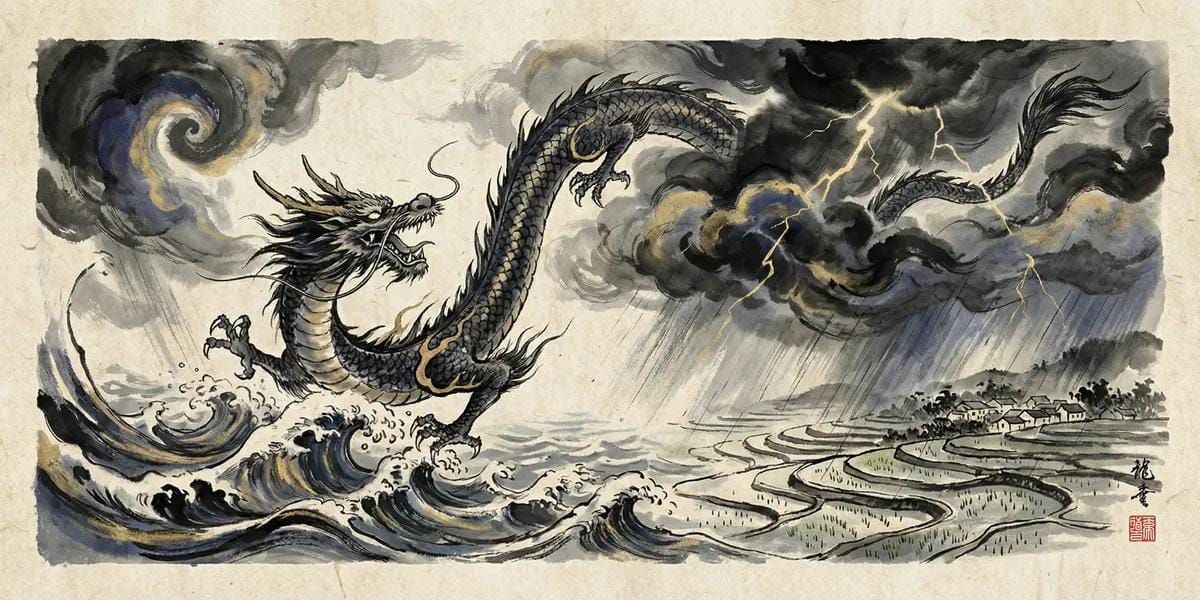
The dragon that calls forth rain
The name Da Qing Long Tang offers another way to contemplate the formula's action.
The dragon belongs to the world of clouds, rain, and the movement of water. In an agricultural society, the ability of water to circulate and fall as rain is inseparable from the flourishing of life.
As a teaching image, we might imagine the great dragon rising into the clouds and calling forth rain where the natural movement of water has become obstructed.
The image should not be mistaken for a literal explanation of the formula. Yet it provides a memorable way to contemplate the relationship between movement, constraint, and the release of fluids.
Da Qing Long Tang promotes sweating in a pattern where the exterior cannot release normally. Its traditional use in a particular overflow-rheum presentation, also discussed in the Jin Gui Yao Lue, reminds us that fluid pathology cannot be reduced to a simple opposition between excess water and insufficient water.
Water must move. The body's capacity to transform and distribute fluids matters as much as their apparent quantity.
The dragon, in this sense, becomes a symbol of restored movement: not merely opening a closed surface, but enabling a constrained process to resume its course.
Beyond the open and closed surface
What I find most valuable about Da Qing Long Tang is not that it breaks the rules. It reveals the limits of a rule when we apply it without considering the whole pattern.
The distinction between Gui Zhi Tang and Ma Huang Tang remains useful. The state of the exterior matters. Sweating or the absence of sweating matters. But these observations do not tell us everything.
We must also ask: What accompanies the constraint? Is there heat? Is the patient robust or weak? Is the pulse floating and tight, or faint and weak? Does the presentation support forceful release, or would such treatment damage what remains of the body's capacity to respond?
These questions move us beyond symptom matching and toward pattern recognition.
Da Qing Long Tang teaches us to see that a closed exterior is not always simply a Ma Huang Tang situation. When vexation and agitation accompany the signs of exterior cold constraint, the internal heat changes the therapeutic task.
The formula does not abandon the logic of Tai Yang treatment. It asks us to understand that logic more completely.
Perhaps this is one of the enduring gifts of the Shang Han Lun: its formulas do not merely teach us which treatment belongs to which category. They teach us to observe the living relationship between the signs, to recognize when a familiar pattern has become more complex, and to allow the whole presentation to determine the direction of treatment.
Sometimes the most revealing formula is the one that refuses to fit our diagram.
And sometimes, when that happens, the best thing we can do is look again.