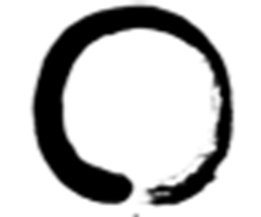
太虚 (Tài Xū) The Void
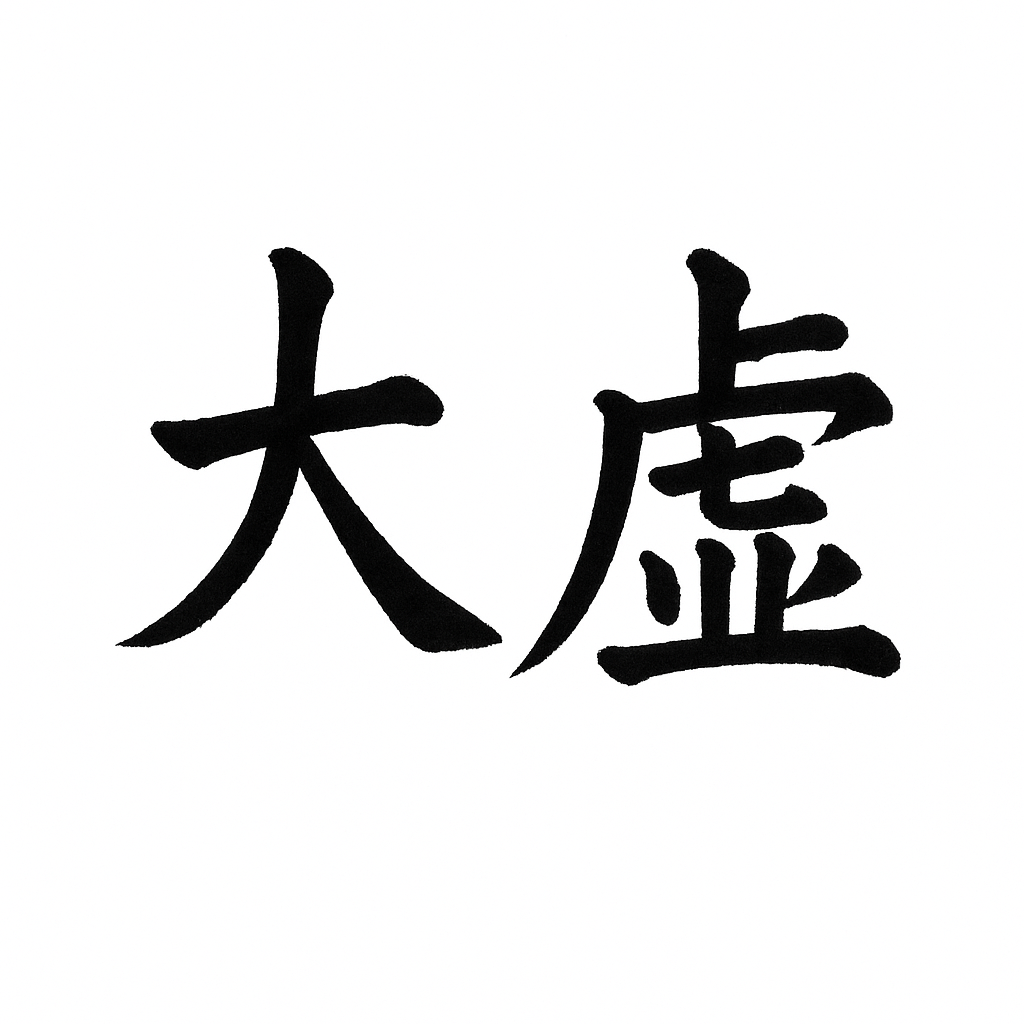
The Void
The void is empty
Empty of what?
Empty of self or what belongs to self.
Empty of eternal or permanent self.
Whatever we are is always changing.
There is nothing permanent about us that we can point to that is what we really are.
There is nothing in the universe that is permanent either.
The Void means to be empty of self.
I came across the concept of the Void, or Great Void, when reading the Yellow Emperor’s Classic. I did some digging and found some information that is very interesting for lovers of ancient Chinese thought.
The Way of Zen
Zen Buddhism and Daoism are a way of liberation. When liberated you are awake.
The way of liberation has no clear definition, it has to be suggested at by saying what it is not. It must be experienced, when this occurs there is a clear “now I see moment”.
This suggesting is like chipping away at rock by a sculptor to reveal an image.
Much like Chinese Medicine and ancient Chinese thought, Daoism is difficult to understand for a Western thinking person. This is mainly caused by an inability to understand and use concepts. Western thinkers uses only words in describing the universe. The difficulty lies in using words to describe the universe and feelings. Words become the limiting factor. Our use of language limits us in understanding the universe.
In English the differences between things and actions are clearly distinguished, but in Chinese words do duty to nouns (things) and verbs (actions). One who thinks in Chinese has little difficulty in seeing that objects are also events. This makes it easier to understand that the universe is a collection of processes, rather than entities*.
*A thing with distinct and independent existence.
In Daoism one seeks a concept that describes how we know to breath without thinking about it. This concept frees the mind from the constriction of the ego.
In ancient Chinese society there are two traditions playing complementary parts-Confucianism and Daoism.
Confucianism
The individual defines himself and his place in society in terms of the Confucian tradition. This includes language, ethics, legal, and ritual conventions. This provides society with a system of communication.
Daoism
Daoism concerns itself with unconventional knowledge, with an understanding of life directly. It is generally the concerns of older people that have fulfilled their role in society, and in retirement seek connections.
The function of Daoism is to undo the inevitable damage of society, this is done in seeking the spontaneous nature of the universe, called ‘self-so-ness”.
The goal in Daoism is not to be free from convention, but not to be deceived by it.
The basic principles of the Dao starts with the indefinable, concrete process of the universe.
Dao means, the way or road.
Laozi tries to convey this indefinability with his text that states, I do not know its name.
There was something vague before Heaven and Earth arose, How calm! How void! It stands alone, unchanging; it acts everywhere, untiring. It may be considered the mother of everything under Heaven. I do not know its name, but call it the word Dao.
And so defines the Dao further as,
The Dao which can be spoken of is not the eternal Dao.
Meaning the Dao is the way of the universe, but in describing it, one is limited in its understanding by words. It must be felt.
Dao is the way, it is the way of the universe. It is indefinable.
The Void and the Dao are the indefinable intelligence of the universe that shapes the world with a skill that is beyond our understanding.
The Dao produces things by not making, which is to say growing. It grows things from within by dividing. This is describes by the I Ching and the concepts of Yin and Yang. Yin and Yang are the father and mother of all things.
In fact we can replace the words Yin and Yang with Dao. Yin and Yang are the way in which the Dao manifests in the universe. This is reflected in the following text.
Yellow Emperor’s Classic,
Huang Di, As for Yin and Yang, they are, the Dao of Heaven and Earth, the fundamental principals governing the myriad beings, father and mother to all changes and transformation.
The basis and beginning of generating life and killing, the palace of Spirit brilliance.
Yin and Yang are the Dao manifesting in the universe, but this creates a problem. When using the concepts of Yin and Yang we are creating an illusion. Yin and Yang are no longer in a state of Dao as unity, but as two things.
This is illustrated in the oldest Zen poem.
The perfect Dao is without difficulty.
Save that it avoids picking and choosing.
Only when you stop liking and disliking will all be clearly understood.
A split hair’s difference, and Heaven and Earth are set apart.
If you want to get the plain truth, be not concerned with right and wrong.
The conflict between right and wrong, is the sickness of the mind.
Liking and disliking, right and wrong, can be compared to the concepts of Yin and Yang.
By defining Heaven and Earth we are set apart from the Dao.
The conflict between right and wrong, Yin and Yang, is the sickness or illusion, of the mind.
Trying to bring unity to the concepts of Yin and Yang we say “the one is two, and the two are one”. Meaning the Dao has two concepts that are not separate from each other, but belong together at all times.
The Dao grows things, and it does so spontaneously.
The Dao’s principal is spontaneity.
It is not a disorderly growing, but it is considered essentially unknowable.
Chuang-tzu, Things are produced around us, but no one knows the whence. They issue forth, but no one sees the portal. Men one and all value that part of knowledge which is known. They do not know how to avail themselves of the unknown in order to reach knowledge. Is this not misguided?
The intelligence of the universe is unknowable, has an spontaneous nature, and we should value the unknown aspect, instead of the known.
The intelligence of the universe does not rule over nature.
The Dao is mysterious and dark.
There is one thing: above it supports Heaven, below it upholds Earth. It is black like lacquer, always actively functioning.
The great Dao flows everywhere, to the left and to the right. All things depend on it to exist, and it does not abandon them. To its accomplishments it lays no claim. It loves and nourishes all things, but does not lord over them.
Darkness
It is black like lacquer.
This the reason that the Water Element is black? Water symbolizes the potential and source of the Dao.
Water flows downward, seeking the lowest places, caves, rivers, the ocean’s depths, where light disappears. Black, being the color of darkness and depth, mirrors this descent and mystery. It represents the unseen, the hidden, and the potential, just as water can be both still and infinitely deep.
The Dao is through and through mysterious and dark xuan.
Xuan darkness is referring to the inconceivability that confronts us when we try to remember a time before our birth and to penetrate its depth.
Dao De Jing, Chapter 1
Mysterious and again mysterious, the gateway to all wonders.
The Dao is only accessible to the mind which can practice the simple and subtle art of we-wei. This is the second principal.
The first is spontaneity and the second is non-doing. Or non-acting.
The simple and subtle way of seeing is not calmness of the mind, but non-graspingness of the mind.
Laozi says this about the non-graspingness mind.
The perfect man employs his mind like a mirror. It grasps nothing, it refuses nothing. It receives, but does not keep.
The idea is to bring the human mind into play with its innate and spontaneous intelligence by using it without forcing it.
This non-grasping mind is to say un-self-consciousness.
This is like looking at things, but making no special effort to take anything in.
This non-grasping mind is the mind in ancient Chinese thought. We call it Heart-mind.
There is the human Heart ren shen. 人心
There is the Dao Heart Dao xin. 道心
The center of the mind is not in the conscious thinking process, not in the ego. When a man has let his mind alone so that it functions in the spontaneous way that is natural to it, he begins to show virtue.
Virtue is seen as effectiveness.
Virtue is the unthinkable ingenuity and creative power of man’s spontaneous and natural functioning-a power which is blocked when one tries to master it in terms of formal methods and techniques.
It is like the centipede’s skill at using a hundred legs at once.
The centipede was happy, quite,
Until a toad in fun said, “Pray, which leg goes after which”?
This worked his mind to such a pitch, he lay in the ditch.
Considering how to run.
Obviously the centipede has lost his Dao shen and virtue.