Tong Ren and Shi: Function, Form, and the Language of Hexagrams

Introduction
In Chinese medicine, images are used to express ideas that are too broad or subtle to define directly. The hexagrams of I Ching, particularly Tong Ren (Hexagram 13) and Shi (Hexagram 7), offer powerful ways to understand the relationship between function and form.
These hexagrams are not merely symbolic—they help us bridge cosmology and clinical practice.
· Function refers to the dynamic processes necessary for life: transformation, movement, and activity.
· Form refers to structure, nourishment, and the material basis that supports function.
In this framework:
· Function expresses Yang
· Form expresses Yin
The Dao: The Origin of Yin and Yang
All of Chinese medicine begins with the concept of the Dao, the source of all life and phenomena. The Dao cannot be fully described—it is known through direct experience rather than analysis.
Much like love, it is something we recognise without needing to define. It governs processes such as breathing: something we do effortlessly, without conscious control.
However, for clinical practice, this intuitive understanding is not enough. To diagnose and treat disease, we rely on structured systems of thought—images and models that allow us to interpret complex processes.
From Dao to Heaven and Earth
From the Dao arise the first distinctions: Heaven and Earth.
These are the primary expressions of Yang and Yin:
· Heaven (Qian): pure Yang — activity, expansion, movement, transformation
· Earth (Kun): pure Yin — structure, nourishment, containment, growth
These images represent the broadest expression of Yin and Yang. However, they are still too general to describe the complexity of living physiology.
From Heaven–Earth to Fire–Water
To describe life more precisely, Chinese medicine uses the images of Fire and Water, two of the Five Agents.
These arise from the interaction of Heaven and Earth and represent how Yin and Yang manifest within living beings:
· Fire expresses Yang within life—activity, warmth, transformation
· Water expresses Yin within life—storage, cooling, preservation
A useful distinction:
· When describing Yang in its most abstract form, we speak of Heaven
· When describing Yang within a living organism, we speak of Fire
The same applies to Yin:
· Earth as the general principle
· Water as its physiological expression
The Role of Tong Ren and Shi
The hexagrams Tong Ren and Shi bring these layers together. They integrate:
· Heaven and Earth (cosmological Yin–Yang)
· Fire and Water (physiological Yin–Yang)
They show how these principles combine into meaningful patterns.
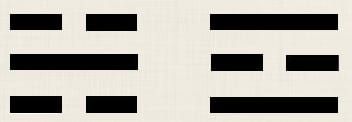
Tong Ren (Hexagram 13): Unity Through Clarity
Structure:
· Upper trigram: Qian (Heaven)
· Lower trigram: Li (Fire)
Fire naturally rises toward Heaven, creating an image of alignment and shared direction.
Tong Ren represents:
· Clarity within (Fire)
· Strength without (Heaven)
It describes a harmonious gathering—individuals united through shared understanding.
A key feature is the presence of a single Yin line among strong Yang lines. This Yin element provides flexibility and cohesion.
Clinical insight:
Yang is active and expansive, but requires Yin to anchor and organise it. Without this, unity cannot be sustained.
Shi (Hexagram 7): Unity Through Structure
Structure:
· Upper trigram: Kun (Earth)
· Lower trigram: Kan (Water)
Water is stored within Earth, hidden yet powerful.
Shi represents:
· Potential strength held in reserve
· Organisation, discipline, and containment
Its qualities are:
· Danger within (Water)
· Obedience and order externally (Earth)
This is the image of an army—powerful, but only effective when structured and directed.
Clinical insight:
Yang must be stored and controlled. Without containment, it becomes unstable and pathological.
The Storage of True Yang
Both Earth (Kun) and Water (Kan) share the ability to store.
What they store is True Yang—the fundamental life force.
This Yang is known by many names:
· Prenatal Yang
· Life Gate Fire (Ming Men)
· Original Fire
· Minister Fire
This stored Yang is essential for life. It warms and activates Yin, enabling nourishment and function.
When balance is lost:
· If Yang is not contained, it rises excessively → agitation, heat, instability
· If Yang is deficient, it cannot transform or warm → cold, stagnation, decline
As described in classical texts:
When Yin fails to contain Yang, it becomes excessive and disordered.
When Yang cannot support Yin, internal communication breaks down.
Health depends on the balance and proper storage of this dynamic.
Conclusion
The hexagrams Tong Ren and Shi offer more than symbolic meaning—they provide a framework for understanding how Yin and Yang interact within both cosmology and physiology.
· Tong Ren shows how clarity and shared direction create harmony
· Shi shows how structure and containment preserve strength
Together, they illustrate a fundamental principle of Chinese medicine:
Life depends not only on the presence of Yin and Yang, but on their relationship—
their balance, their organisation, and their ability to support one another.