Varicella Zoster

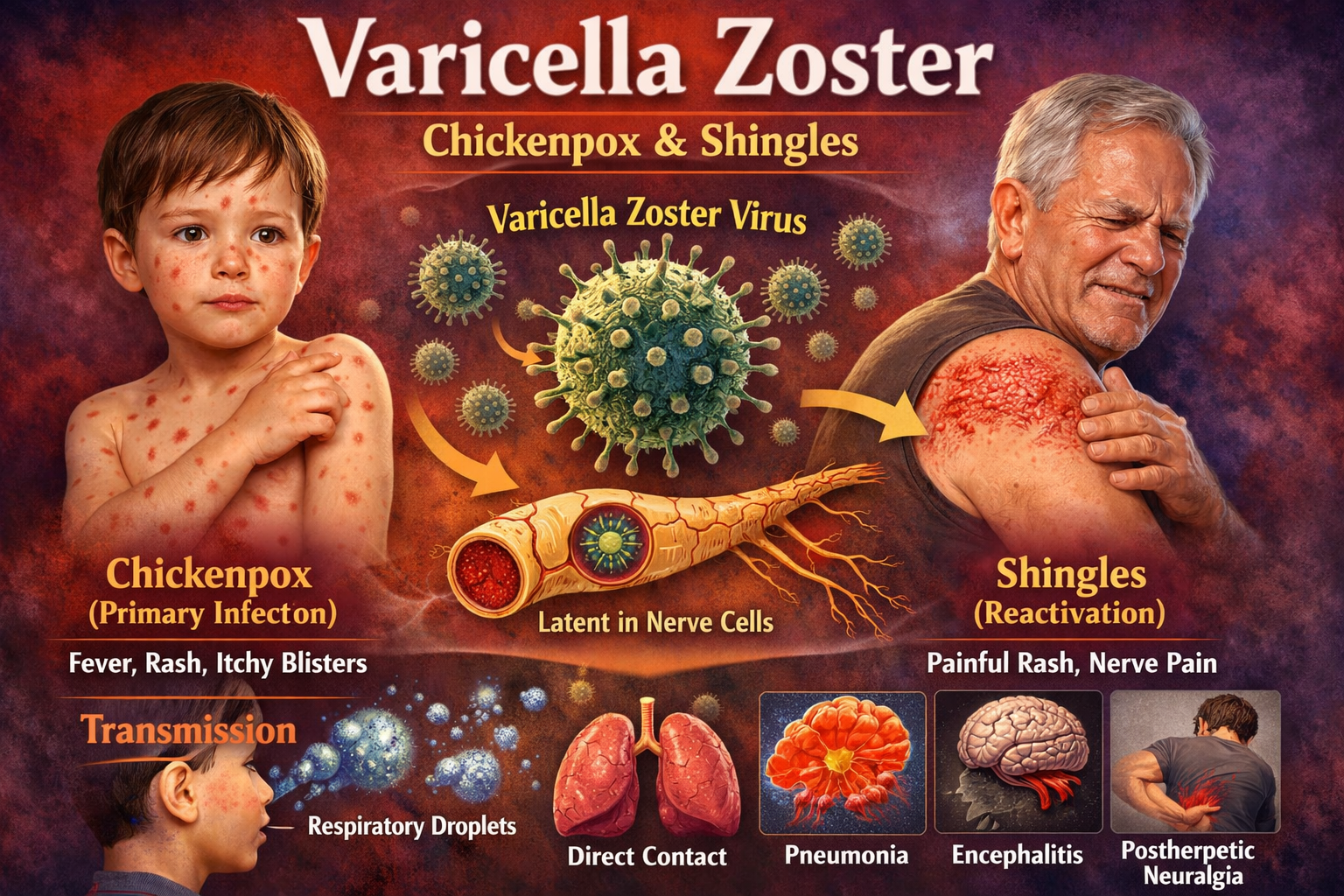
In the last month I have see two acute cases of Varicella Zoster, commonly called shingles, in adults. In Dutch they call it Gordel roos.
You may find it interesting, that both cases presented with the same pulse and that can be translated into the formula Chinese herbal formula chai hu gui zhi tang. I am no fan of protocols in Chinese Medicine, and namely because it can lead to poor clinical results, and does not deepen our understanding of our vocation. But, it can be helpful when starting out and wanting good clinical results first, and knowledge second.
Varicella-zoster virus is an infection that causes multiple illnesses. It first causes chickenpox (also called varicella), an itchy rash. Then, it goes dormant in the nerves. If the immune system is weakened, it can come out again as shingles, a painful rash along a nerve.
Varicella-zoster virus is a member of the herpesviridae family of viruses, making it a herpesvirus. It can infect children or adults. It is very contagious and can be dangerous in people with weakened immune systems. Most people have a weakened immune system due to modern living styles. Just not enough rest and relaxing going on.
Chai hu gui zhi tang
Chai hu gui zhi tang treats two different patterns at the same time. This formula treats a combined Tai yang wind strike and Shao yang damp heat pattern.
In both cases I can say that there was a pre-condition of Shao yang damp heat before they got sick with the Tai yang wind strike.
And both cases presented with extreme muscle and body aches. Which is what is described in the Shang Han Lun on line 146.
146 When in cold damage that has lasted for six or seven days, there is heat effusion, mild aversion to cold, vexing pain of the limb joint, mild retching, propping below the heart, and the exterior pattern is still present, chai hu gui zhi tang governs.
In the cases that I treated the pain was localized along the Gall bladder vessel on the mid back.
Apparently the Western Doctors are not sure why adults get a flare up of a childhood disease. In Chinese Medicine the cause is clear. It is clear because the formula that is used to treat it describes how the disease manifests.
In a Shao yang disease the circulating Yang, also known as the Ministerial Fire, Original Fire, True Fire, Dragon Fire, has become weak. There are different reason why this can occur, but the weak Yang in turn causes the accumulations of dampness to rise. The normal physiological process of the body require a strong presence of Yang qi for warmth and for circulation. When this fails, fluids start to accumulate. This dampness starts to warm up and ends up causing circulation problems on top of the already weak Yang circulation.
So weak Yang causes damp and heat to accumulate. Yet, Yang is needed to protect the surface and the interior. A weak Yang makes it easy for us to get a Tai yang wind strike pattern.
The formula chai hu gui zhi tang clears the damp and heat so proper circulation can be restored. It is the chai hu and huang qin that clear the damp and heat.
Chai hu gui zhi tang
chai hu 24 huang qin 9 ban xia 12 ren shen 9 gui zhi 9 bai shao 9 sheng jiang 9
da zao 9 zhi gan cao 9
Tai yang symptoms, runny nose, body aches with mild sweating and fever.
Shao yang symptoms, sore throat, bitter taste and blurry vision, and body aches.
Gui zhi and zhi gan cao are tonifying the Yang of the Heart. This strengthens the Yang on the surface to stop the sweating. They also strengthen the weak Yang that allowed the sickness to manifest.
Bai shao and zhi gan cao are nourishing Yin fluids and Blood. They nourish the concept of Earth, which is a combination of the Earth and Water Elements.
Sheng jiang is raising the Clear Qi of the Tai yin Spleen up to the 100 vessels to replace the lost fluids during excessive sweating.
The ren shen, da zao, bao shao and zhi gan cao are nourishing the Clear Qi that is being raised by shang jiang.
Sheng jiang and ban xia are transforming the excess phlegm and dampness in Earth. Earth as in the whole body, even the surface, but also locally in the Yang ming Stomach.
Ban xia descends the Yang ming Stomach while transforming dampness and phlegm in the body, Lungs, and Stomach family. The Stomach family is the Stomach organ, small and large intestine.
Chai hu is freeing the movement of Yang by transforming dampness and phlegm in the realm of the San jiao. It also decongests the Liver and Gall bladder organs.
Huang qin is the great cleaner. It clears damp and phlegm in the Yang ming Stomach family. It clears damp and heat in the Lungs and on the surface.
Yi Yi Ren and Yin Chen Hao might be good for modifying the formula to make it better at clearing dampness on the surface.
Yi yi ren, Coicis semen
Shen Nong Ben Cao Jing, Yi yi ren is of sweet flavor and slightly cold. It governs urgent restriction and spasms of the tendons, with inability to bend or stretch; it treats wind damp obstruction, and descends qi. Prolonged ingestion lightens the body and benefits qi.
Yi yi ren is sweet tonifying, moving and cooling of excess warm fluids in the Stomach domain, Spleen, Kidneys, and Bladder. It transforms hot dampness and phlegm while disinhibiting urination and dispelling pus.
Yi yi ren, mu tong, and fang ji, all leach dampness and promote the elimination of water stagnation through increased urination.
Formulas, ma huang xing ren yi yi gan cao tang, yi yi fu zi san, wei jing tang
Yin chen hao, Artemisiae scopariae herba
Yakucho, It governs the treatment of yellowing
Shen Nong Ben Cao Jing, Yin chen is of bitter flavor and neutral. It governs the treatment of the evil qi of wind damp chills and fever, it treats heat congestion jaundice.
Yin chen hao is bitter draining of damp and heat in the Stomach and Spleen. It is bitter draining of heat in the Liver Blood and Ministerial Fire. It is the core herb for jaundice, it clears heat and percolates dampness.
It clears the congestion of Gall bladder and Liver stagnation damp heat resulting in dampness heating up causing yellowing. The Ministerial Fire is only hot when it stagnates.
Formulas, yin chen hao tang, yin chen wu ling san
Gui zhi, Cinnamomi cassiae ramulus is pungent sweet and warm dispersing of the Imperial Fire. It warms and tonifies the Shao yin and Jue yin. In doing so it warms and tonifies the whole body.
Bai shao, Paeoniae radix lactiflora is sour, bitter and cool. It is sour collecting of Yin fluids and Blood. It is bitter descending of heat. It nourishes dryness in Yang ming and the Jue yin. It descends Earth and Metal and calms Wood wind.
Sheng jiang, Zingiberis rhizoma recens is pungent dispersing of the Liver and pericardium Blood and the Ministerial Fire in the San jiao. Sheng jiang is pungent dispersing of dampness and cold in the Stomach domain, Spleen and Lung. Sheng jiang is pungent connecting of the Tai yin with the Tai yang. It supports raising of the Clear qi to the chest and the 100 vessels.
Da zao, Jujubae fructus is sweet tonifying and moderating. It tonifies and nourishes the Stomach domain, Spleen, Lungs, and Heart. It directly nourishes the Shao yin Heart.
Gui zhi, da zao and zhi gan cao tonify and nourish the Heart. Da zao calms excessive movement of Wood wind.
Zhi gan cao, Glycyrrhizae radix prep is sweet tonifying and nourishing of all organs but especially the Heart.
Zhi gan cao is sweet and mildly warm tonifying and nourishing of Yin fluids. It balances the pungent gui zhi with its sweet moderation and nourishing. It nourishes Yin fluids in the Tai yin and Shao yin. It calms wind in the Jue yin.
Chai hu, Bupleuri radix is bitter draining of damp and heat in the Liver, Gall bladder and San jiao. It is pungent and aromatic dispersing of heat in Liver Blood and the Ministerial Fire in the San jiao.
Huang qin, Scutellaria radix is bitter draining and cooling of heat in the San jiao, Stomach domain, Lungs, Liver, Gall bladder, and Bladder.
Ban xia, Pinelliae rhizoma is pungent dispersing of the Liver Blood and the Ministerial Fire in the San jiao. It is pungent dispersing of the cold and dampness in the Stomach domain, Spleen and Lung. It transforms Tai yin damp phlegm generated from excessive and stagnant cold dampness and counteracts nausea and adverse flow.
Ban xia is combined with sheng jiang which forms the formula xiao ban xia tang. It treats damp and phlegm accumulation in the Yang ming Stomach that causes vomiting. Ban xia and sheng jiang are a core pair of herbs for dampness and phlegm accumulation. Ban xia transforms phlegm and sheng jiang disperses dampness.
Ren shen, Ginseng radix is sweet tonifying and nourishing of the Spleen, Lungs, Heart, and Kidney. It nourishes Yin fluids and therefore is the foremost Qi and Yin tonic. The Yin fluids from ren shen moderate excessive movement by anchoring Yang with Yin. It raises the Original qi and Gathering qi. It strengthens Rrighteous qi, which is also called True qi and is a combination of Original qi and Gathering qi. All are dependent on the Qi of Shao Yin and Tai yin. Which in turn are dependent on the Jue yin and Shao yang for the Ministerial Fire in all three burners.
Conclusion
The appearance of Varicella Zoster in adults is often puzzling from a purely biomedical perspective, yet from the viewpoint of Chinese Medicine it follows a clear and logical pathway. The two cases described demonstrate how an underlying Shao yang imbalance can create the internal conditions that allow an external Tai yang wind strike to penetrate and manifest as shingles. What seems like a sudden and unpredictable flare-up is, in reality, the expression of deeper patterns of weakened Yang, impaired circulation, and accumulated damp heat.
Chai hu gui zhi tang provides a precise and elegant response to this complex situation. By harmonizing Tai yang and Shao yang, dispersing constrained heat, transforming dampness, and supporting the Righteous qi, the formula addresses both the root and the branch of the disorder. Its classical indications from the Shang Han Lun continue to prove remarkably relevant in modern clinical practice.
These cases remind us that ancient formulas are not relics of the past, but living tools capable of interpreting and treating contemporary illnesses. When we listen carefully to the pulse, the symptoms, and the principles handed down through tradition, the logic of the medicine reveals itself - and effective treatment naturally follows.