From Dao to the Living Body


A simple architecture of Chinese medicine
I have come to think that it is not necessary to understand every aspect of ancient Chinese thought in order to understand Chinese medicine.
This may seem like a strange conclusion, because Chinese medicine is surrounded by a remarkable number of ancient systems of thought: the Dao, Yin and Yang, the Eight Trigrams, the Five Phases, the Heavenly Stems and Earthly Branches, the Six Conformations, cosmology, astrology, and many others.
It is tempting to try to fit all of these systems together into one coherent picture.
But perhaps that is asking them to do something they were never intended to do.
Different people, at different times, used different symbolic systems to describe the relationships that mattered to them. One example that prompted me to reconsider this was the observation that astronomers could use one configuration of the Heavenly Stems while agriculturists used another. Both were attempting to place Earth within a larger pattern, but each was looking from a different perspective.
Perhaps Chinese medicine can be approached in the same way.
Rather than trying to make every ancient system into one system, we can ask a simpler question:
What is the common phenomenon that all of these systems are trying to describe?
For me, the answer is Change and Transformation.
The Dao: Change before distinction
The Dao is the unfathomable source from which change arises.
It has been described as darkness and the great void—not because it is simply empty, but because it lies beyond our ability to completely comprehend or define it.
The Dao is not a thing among other things.
It is the underlying principle through which things come into being, change, transform, and return.
Its most important characteristic for our purposes is therefore not something that can be named or grasped.
It is change itself.
From this undifferentiated source, distinctions begin to appear.
Yin and Yang: Change becomes polarity
The first distinction we can recognize is Yin and Yang.
Yin and Yang are not two separate substances or forces existing independently of one another. They describe the complementary polarities through which change becomes perceptible.
One rises while the other descends.
One expands while the other contracts.
One becomes visible while the other remains hidden.
They separate, interact, transform into one another, and continually give rise to new relationships.
Thus the Dao becomes perceptible through polarity.
Dao → Yin and Yang
The unknowable becomes recognizable through the movement of its polarities.
Heaven and Earth: Polarity becomes manifestation
As Yin and Yang differentiate, we can speak of Heaven and Earth.
Heaven represents the initiating and creative movement.
Earth represents the receptive and formative movement.
But “receptive” should not be understood as passive.
Earth does not merely receive something that Heaven does to it. Earth gives form to the creative impulse.
Heaven initiates.
Earth gives form.
Through their interaction, the potential of Yin and Yang becomes the world of manifestation.
Yin and Yang → Heaven and Earth → manifestation
At this point, we do not need to explain every cosmological system that developed around these ideas.
We only need to recognize the fundamental movement:
something undifferentiated becomes differentiated, and differentiation gives rise to form.
The Five Phases: Manifestation becomes transformation
Once things have taken form, they do not remain still.
Everything that manifests participates in a continual process of transformation.
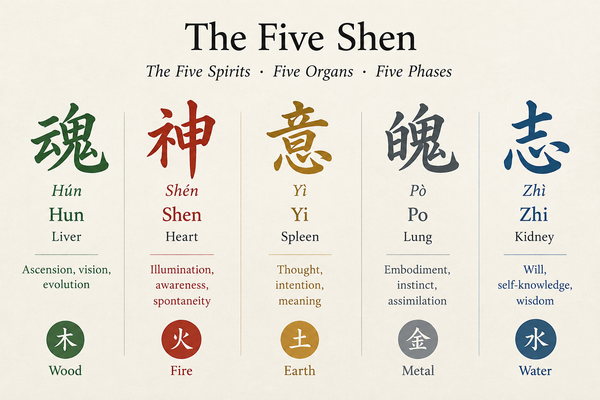
The Five Phases provide one way of describing the characteristic movements of this transformation.
Wood rises.
Fire expands and manifests.
Earth transforms and nourishes.
Metal contracts and returns.
Water stores and preserves.
These are not five substances.
They are patterns of movement.
The Five Phases therefore allow us to observe what kind of transformation is taking place.
They describe the rhythm of life as it unfolds through time.
Heaven and Earth → patterns of transformation → Five Phases
The Six Conformations: Transformation becomes functional
Now we can bring the process into the living body.
The human body is not separate from the processes of nature. It is one of their manifestations.
The same principles of movement, differentiation, transformation, expansion, contraction, opening and closing are expressed within living physiology.
The Six Conformations provide another way of looking at this process.
They describe not simply what is transforming, but how transformation is organized and functions within the living body.
They give us relationships such as opening, closing, pivoting, storing, and transforming.
The Five Phases and the Six Conformations therefore need not be identical systems.
They answer different questions.
The Five Phases describe:
What pattern is transformation taking?
The Six Conformations describe:
How is transformation functionally organized within the living organism?
This distinction allows us to appreciate both systems without forcing them into a single structure.
From the Dao to medicine
Seen in this way, the great progression becomes remarkably simple:
Dao
The source of change.
↓
Yin and Yang
The polarities through which change becomes perceptible.
↓
Heaven and Earth
The orientation through which potential becomes manifestation.
↓
Five Phases
The patterns through which manifestation transforms.
↓
Six Conformations
The functional organization of transformation within the living body.
And beneath the entire progression is one continuous movement:
Change → differentiation → manifestation → transformation → embodiment
Chinese medicine begins to make sense when we see the human being not as a collection of separate parts, but as a living expression of this continual process.
Health is therefore not simply the possession of a fixed state.
It is the ability to transform appropriately.
To open when opening is needed.
To close when closing is needed.
To rise and descend.
To expand and contract.
To receive and transform.
To store and release.
To move between Yin and Yang without becoming fixed in either.
Disease can then be understood, at least in part, as a disturbance in this movement.
Something that should move does not move.
Something that should descend rises.
Something that should transform fails to transform.
Something that should open remains closed.
Something that should close remains open.
The practitioner therefore does not merely ask, “What substance is missing?” or “What structure is damaged?”
The deeper question becomes:
How has transformation become disordered?
And treatment becomes an attempt to restore the movement.
Many maps, one landscape
Perhaps this is why we do not need to force every ancient Chinese system into one unified diagram.
The Eight Trigrams, the Five Phases, the Heavenly Stems and Earthly Branches, the Six Conformations, and other traditional models can be understood as different maps.
They may emphasize different relationships.
They may organize the same world according to different purposes.
They need not all be identical in order to be meaningful.
What they share is the recognition that life is not static.
Life is relationship.
Life is movement.
Life is transformation.
And Chinese medicine is one particular way of observing that transformation within the living body.
Perhaps that is enough.
We do not need to explain everything that the ancient Chinese understood in order to appreciate what Chinese medicine is saying.
We only need to follow the movement:
From the Dao, change arises.
From change, Yin and Yang emerge.
From Yin and Yang, Heaven and Earth appear.
From Heaven and Earth, the patterns of transformation unfold.
And within the living body, those transformations become functional, rhythmic, and embodied.
The maps may be many.
The landscape is one.