When Is Fear Not Fear?

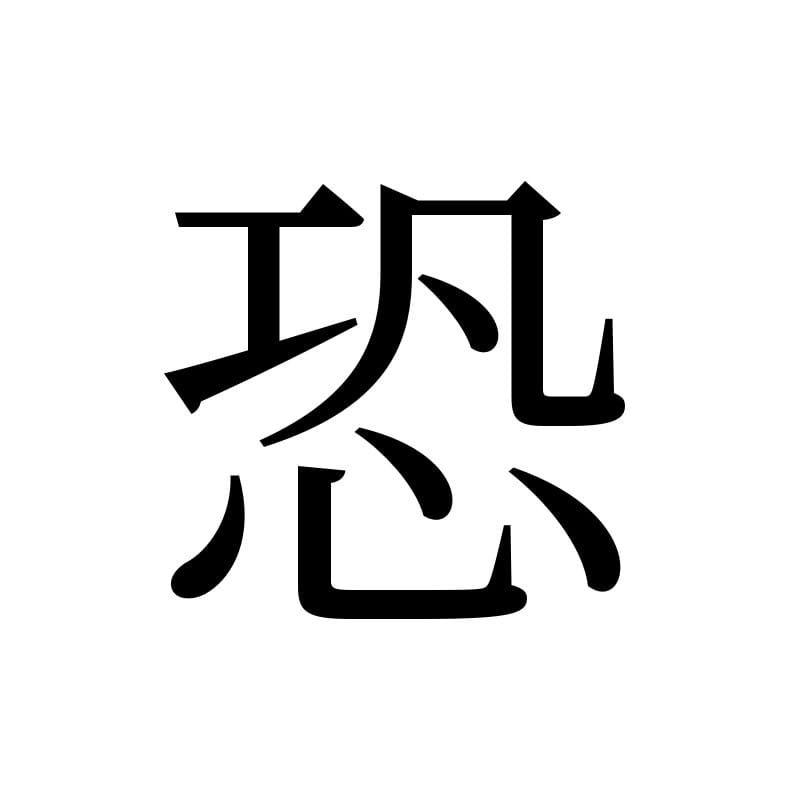
In Chinese Medicine, we often learn that fear belongs to the Kidneys. This is a useful starting point, but the Classical texts invite us to look more carefully.
The word translated as “fear” in English does not always represent the same experience in Classical Chinese.
Three words become particularly interesting:
- 恐 kǒng — fear, apprehension, dread
- 驚 jīng — fright, alarm, being startled
- 躁 zào — agitation, restlessness, fidgeting
If we translate all three simply as “fear” or “anxiety,” we lose an important part of the clinical picture.
Fear in the Liver
In chapter 8 of the Ling Shu, we find:
肝藏血,血舍魂,肝氣虛則恐,實則怒。
Gān cáng xuè, xuè shè hún, gān qì xū zé kǒng, shí zé nù.
The Liver stores the Blood; the Blood houses the Hun. When Liver qi is deficient, there is Fear 恐; when it is replete, there is Anger 怒.
Here the character is 恐 kǒng.
This is particularly interesting because we normally associate 恐 with the Kidneys and Water. Yet here the Ling Shu explicitly associates Liver qi deficiency with 恐.
This does not necessarily contradict the Five Zhi model. Rather, it reminds us that an emotional manifestation cannot always be understood simply by assigning it to one organ.
The same emotional word can arise through different physiological circumstances.
The passage also gives us a beautiful polarity:
肝氣虛 → 恐
Liver qi deficient → fear
肝氣實 → 怒
Liver qi replete → anger
The emotional expression changes according to the state of the Liver.
Fright in Chai Hu Jia Long Gu Mu Li Tang
Now we can look at Chai Hu Jia Long Gu Mu Li Tang.
Line 107 When in cold damage that has lasted for eight or nine days, precipitation is used, and there is fullness in the chest, vexation and fright, inhibited urination, delirious speech, heaviness of the entire body, and inability to turn sides, chai hu jia long gu muli tang governs.
The Shang Han Lun describes:
胸滿煩驚,小便不利,譫語,一身盡重,不可轉側者,柴胡加龍骨牡蠣湯主之。
Among the signs are:
胸滿煩驚
xiōng mǎn fán jīng
Chest fullness, vexation and fright.
Notice the word:
驚 jīng — not 恐 kǒng.
This is a small difference in the Chinese characters, but potentially a large difference in our understanding.
驚 jīng carries the sense of being startled, alarmed, frightened or shaken.
Therefore, rather than saying that Chai Hu Jia Long Gu Mu Li Tang treats “fear,” it is more precise to say that the formula addresses a presentation characterized by 煩驚 — vexation and fright/alarm.
This is not the same word used in the Ling Shu statement:
肝氣虛則恐
So we should resist collapsing the two into the single English word fear.
Three Different Expressions
We can begin to see a useful distinction:
|
Classical term |
Pinyin |
Possible clinical
sense |
|
恐 |
kǒng |
fear, dread, apprehension |
|
驚 |
jīng |
fright, alarm, being startled |
|
躁 |
zào |
agitation, restlessness, fidgeting |
And this becomes especially interesting when we compare two formulas containing 龍骨 Long Gu and 牡蠣 Mu Li.
Long gu, Mastodi fossilium ossis
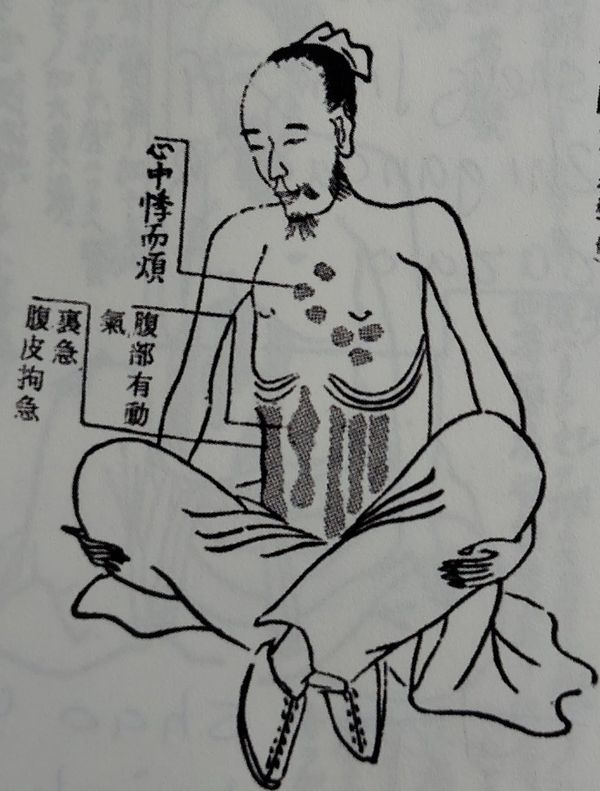
The Yakucho states: It governs the treatment of pulsing below the abdomen. On the side it treats vexation, fright, and loss of semen.
Mu li, Ostrea concha
The Yakucho states: It governs the treatment of pulsing in chest and abdomen, and on the side treats fright, mania, vexation and restlessness.
Chai Hu Jia Long Gu Mu Li Tang
Line 107 When in cold damage that has lasted for eight or nine days, precipitation is used, and there is fullness in the chest, vexation and fright, inhibited urination, delirious speech, heaviness of the entire body, and inability to turn sides, chai hu jia long gu muli tang governs.
煩驚
fán jīng Vexation + fright/alarm
Gui Zhi Gan Cao Long Gu Mu Li Tang
Line 118 If adverse treatment by fire is followed by precipitation, and because of red hot needling there is vexation and agitation, gui zhi gan cao long gu mu li tang governs.
煩躁
fán zào Vexation + agitation/restlessness
There is a clear family resemblance:
- both contain Long Gu and Mu Li
- both follow inappropriate treatment
- both contain 煩 vexation
- both involve disturbance of normal regulation and settling
Yet one word changes:
煩驚 → vexation + fright
煩躁 → vexation + agitation
That small difference may be clinically significant.
The Classical text is giving us more information than the English word “anxiety” can convey.
Fear, Fright and the Movement of the Shen
Fear, Fright and the Movement of the Shen
This also gives us another way to understand the Ling Shu discussion of the Shen.
The chapter states:
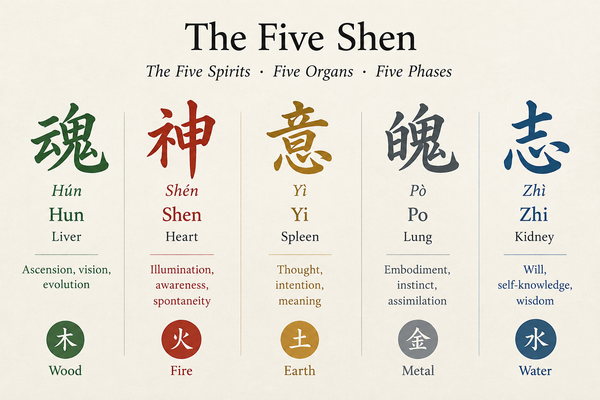
腎藏精,精舍志
The Kidneys store Essence; Essence houses the Zhi.
And:
兩精相搏謂之神
When the two Essences interact, this is called Shen.
隨神往來者謂之魂
That which follows Shen in its coming and going is called Hun.
The Liver is the dwelling place of the Hun.
This gives us a fascinating movement:
Kidney → Jing → Zhi → direction
and
Liver → Blood → Hun → movement and unfolding
We might therefore understand the relationship poetically:
The Kidneys preserve the hidden potential of life; the Zhi gives that potential direction. The Liver and Hun give it movement, allowing what is hidden to rise toward manifestation.
This is an interpretation rather than a literal definition of the classical terms, but it gives us a useful framework for thinking about the relationship between Heaven, potential, direction, movement and manifestation.
Water
The Water Element is the worldly manifestation of the first stage in the movement of the Dao.It is seen as pure potential and is the source/mother of the world.
It is called the Great. Chapter 25 DDJ
I do not know its name.
Its symbol is called Dao.
If I tried to make its name, I would call it great.
Being great speaks of departing.
Departing speaks of being remote.
Being remote speaks of returning.
Something existed unformed yet complete,
Before heaven and earth were created.
Silent! Empty!
Standing alone, not changing.
It circulates everywhere, and causes no danger.
It can be considered the mother of the world.
志 Zhì
The virtue of Water is wisdom.
The Heart Shen can illuminate our depths but can only reach so far, what lies beyond our awareness and intuition are unknown.
Fear is the emotion that arises in the face of the unknown.
The sage through cleaver utilization and a focused will cultivates wisdom.
Wisdom is the virtue that empowers us to stand firmly in the face of the unknown and take the right action instinctively.
Thank you L. Jarret
The Clinical Lesson
The important lesson is not that we should replace one definition of fear with another.
It is that we should read the Classical language carefully.
When we see:
恐
we should ask:
What kind of fear or dread is being described?
When we see:
驚
we should ask:
What has startled or alarmed the person? What has disturbed their ability to settle?
And when we see:
躁
we should ask:
What is unable to settle and why is the person restless?
The words are related, but they are not interchangeable.
So perhaps the title of the lesson says it all:
When Is Fear Not Fear?
The answer is:
When we translate three different Classical experiences into one English word.
And that, I think, is a valuable lesson for students of Classical Chinese Medicine: the character matters.