八法 (Bā Fǎ)

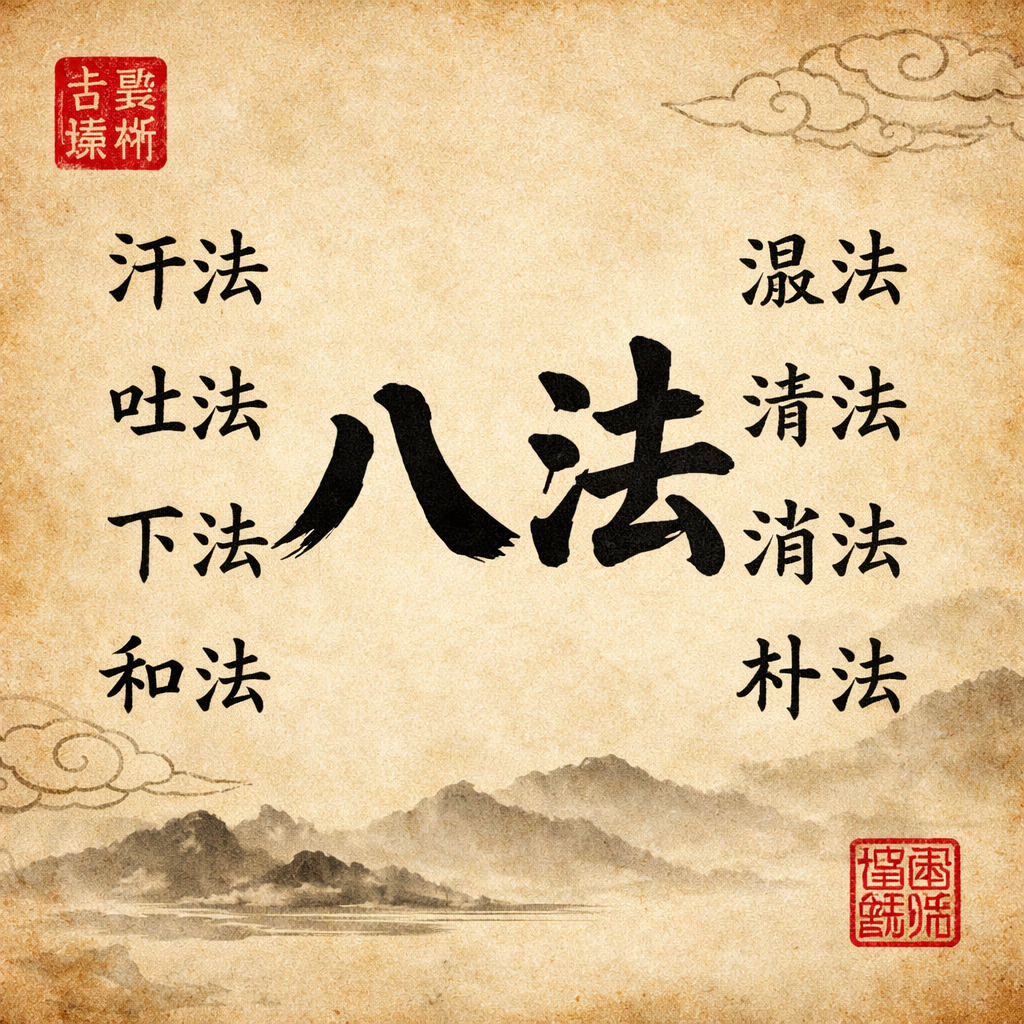
In contemporary Chinese Herbal Medicine education, herbs and formulas are commonly taught through the framework of the Eight Methods. While this system is clinically useful, it presents a challenge for students because it is not rooted in the foundational principles of Chinese Medicine.
The classification of herbs and formulas into categories such as Sweating, Vomiting, Draining Downward, Harmonizing, Warming, Clearing, Reducing, and Tonifying originates with Cheng Zhong-Ling of the Qing dynasty. In 1732, in his Yixue Xinwu (医学心悟), he organized treatment strategies into what we now call the Eight Methods (八法, Bā Fǎ):
汗法 (Hàn Fǎ) — Sweating
吐法 (Tǔ Fǎ) — Vomiting
下法 (Xià Fǎ) — Draining downward / Purgation
和法 (Hé Fǎ) — Harmonizing
温法 (Wēn Fǎ) — Warming
清法 (Qīng Fǎ) — Clearing
消法 (Xiāo Fǎ) — Reducing / Dissolving
补法 (Bǔ Fǎ) — Tonifying
These are methods of treatment. They describe what we do in clinic. But they do not, in themselves, explain how herbs function within the body.
The foundations of Chinese Medicine are Yin and Yang, the Five Phases (Wu Xing), and the Six Conformations (Liu Jing). These describe physiology, pathology, and transformation. If we want to truly understand herbs and formulas, we must define them through these principles.
All herbs and formulas simultaneously reflect physiology, pathology, and treatment.
Take Gui Zhi (桂枝, Cinnamomi cassiae ramulus) as an example.
Gui Zhi expresses both Yang and Yin. It is Yang in that it warms and promotes movement; it is Yin in that it nourishes and harmonizes. It engages multiple phases: it supports Wood by promoting movement, assists Fire by warming and activating, and influences Water by facilitating transformation. Within the Six Conformations, it operates in Tai Yang by warming and releasing the exterior, while also connecting with Shao Yin by warming the Heart and Kidneys. Tai Yang and Shao Yin form an exterior–interior pairing.
Describing an herb in this way gives us a functional understanding of how it participates in both normal physiology and disease processes. From this perspective, it becomes clear why Gui Zhi appears in Sweating, Warming, and Tonifying categories, these are outcomes of its function, not its definition.
When learning a new herb, begin with its nature: its Yin-Yang qualities, its relationship to the Five Phases, and its role within the Six Conformations. Then look at the formulas it appears in, and ask what function it is serving within that context.
One of my favourite formulas in clinical practice illustrates this well:
Gui Zhi Jia Shao Yao Sheng Jiang Ge Yi Liang Ren Shen San Liang Xin Jia Tang
桂枝加芍藥生薑各一兩人參三兩新加湯
Gui Zhi 9g
Bai Shao 12g
Sheng Jiang 12g
Da Zao 6g
Zhi Gan Cao 6g
Ren Shen 9g/12g
This is one of the longest-named formulas in the Shang Han Lun, appearing in line 62:
“When, after inducing sweating, there is generalized body pain and a deep, slow pulse, Gui Zhi Jia Shao Yao Sheng Jiang Ge Yi Liang Ren Shen San Liang Xin Jia Tang governs.”
A deep and slow pulse reflects a loss of Yang transformation, alongside depletion of Yin fluids. Excessive sweating has damaged both aspects, leading to generalized pain. This dual loss of Yin and Yang places the condition within the category of taxation disorders described in the Jin Gui Yao Lue.
Understanding the formula through foundational principles:
Gui Zhi warms and restores Yang transformation, supporting the movement from Wood into Fire. Together with Zhi Gan Cao, it supports the Heart’s Earth aspect and harmonizes the center.
Gui zhi and Zhi gan cao form the formula gui zhi gan cao tang, which treats Heart Yang deficiency.
Sheng Jiang warms the Earth and transforms fluids, helping to distribute them upward. In combination with Gui Zhi, it assists in mobilizing and dispersing fluids to the surface, relieving pain.
Bai Shao nourishes Yin, supporting Wood and moderating the movement of Yang. With Zhi Gan Cao, it relaxes tension and alleviates pain.
Bai shai and Zhi gan cao form the formula shao yao gan cao tang, which treats generalized pain.
Da Zao and Ren Shen strengthen the Earth, generate fluids, and restore the material basis of both Yin and Yang. Ren Shen, in particular, helps reconnect the relationship between Heart (Fire) and Kidneys (Water).
Through this lens, the formula is not simply “warming” or “tonifying.” It restores the dynamic relationship between Yin and Yang, supports the interplay of the phases, and re-establishes the proper movement of Qi and fluids across the Six Conformations.
When we describe herbs and formulas in terms of Yin and Yang, the Five Phases, and the Six Conformations, we move beyond memorizing categories. We begin to understand medicine as a reflection of living physiology.
This is where formulas come alive.